Blog
What Makes a Good Opal? Key Elements that Determine Value
In Pearl Jewellery04 Jan 2016 | No Comments
In addition to being beautiful to look at, the finest opals can be astonishingly valuable.
Take the Olympic Australis, the world’s largest and most expensive opal, for example. Discovered at Coober Pedy in 1956, the 17,000-carat stone was most recently valued at over $2.5 million. The Virgin Rainbow, another opal found in South Australia, has also received valuations of over $1 million.
While these examples highlight the top end of the market, opals span a wide variety of price points. In this article, we’ll explore what makes one stone more valuable than another, meaning you’ll know how to choose a good quality opal when shopping for your next piece. We’ll cover how differences in colour, brightness, pattern, cut, weight and inclusions can also impact the value of an opal.
Key Takeaways
- Black opals are usually the most valuable type of opal, due to their rarity.
- Darker body tones can make the play of colour stronger or more dramatic.
- A strong play of colour from multiple angles increases an opal’s value.
- Clean stones with fewer visible inclusions are generally worth more
- Treatments and water absorption can both impact an opal’s value.
- Natural solid opals are usually worth more than doublets or triplets.
1. Country of origin
Australia is the world’s leading source of opals. In fact, more than 90% of the world’s opals are found in South Australia, New South Wales and Queensland. Buyers associate Australian opals with quality and consistency, key factors in their ongoing high value.
Depending on the type of opal you are looking at, you will likely hear references to a number of Australian opal mining locations. Lightning Ridge is especially famous for being the home of the black opal, while boulder opals are mainly found in Queensland and white opals in South Australia.
2. Opal Type
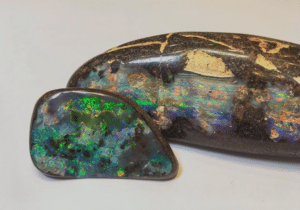
There are two categories of opals: precious and common. Precious opals display the shifting flashes experts refer to as the play of colour and are what most people think of when they picture the gemstone. A common opal does not display a play of colour.
Within the category of precious opals, there are various types:
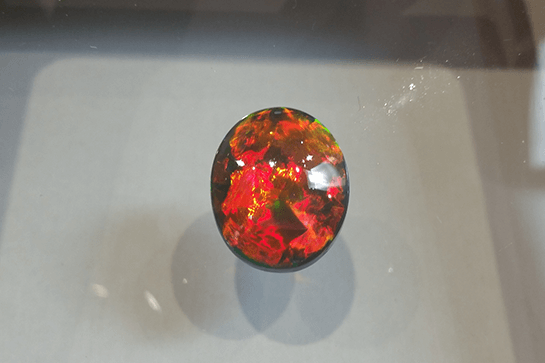
- Black opal: The rarest and most valuable, because its dark body tone makes colours more vivid.
- Boulder opal: Highly valued and usually sold still attached to the natural rock it formed in.
- White opal: A light-toned variant of the gemstone that is more abundant but still highly valuable.
- Crystal opal: Transparent or translucent variations that display exceptional brightness.
- Doublets and triplets: Assembled stones that combine a thin slice of opal with backing materials.
3. Body tone (for black Opal)
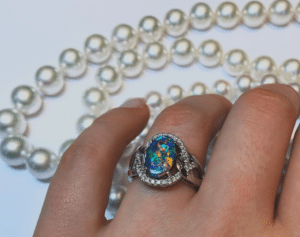
The body tone refers to the background of the opal itself, not the flashes of colour on top. Black opals range from a completely black base through to various shades of very dark grey.
Experts use the N1 to N9 scale to grade an opal’s body tone. N1 is jet black, with N9 being the palest. Black opals usually have a rating no higher than N4.
As a rule, the darker an opal’s body tone, the more valuable it is. The darker base creates stronger contrast, allowing the flashes of red, green, blue and orange to appear more vivid when light hits the opal.
You can read more about the grading process in this Opal Body Tones guide.
4. Play of colour
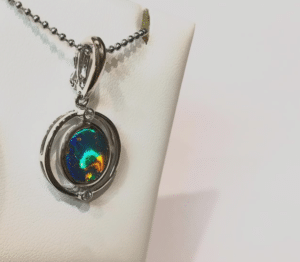
Play of colour is the defining feature of a precious opal. It refers to the ability of the stone to display a rainbow of colours when light hits it, which is the primary measure of what makes a good opal for some buyers.
The most valuable opals show a bright play of colour from all angles, with stones that show the full spectrum being especially desirable.
Directionality also factors into the play of colour. Experts may talk about an opal ‘facing up’, a term used to describe the movement of colours through the stone. Descriptors include:
- Non-directional or all-angle colour: The colour shows strongly from many angles; this is usually the most desirable.
- Broad flash: Large areas of colour appear and disappear as the stone moves.
- Rolling flash: Bands or waves of colour seem to roll across the surface as the viewing angle changes.
- Pinfire: Tiny pinpoint flashes scattered across the stone. Attractive, but usually less valuable than larger, more dramatic patterning.
5. Fire
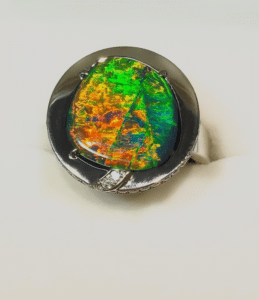
‘Fire’ is the everyday term given to a gemstone’s brightness or intensity of colour. As a rule, the stronger and clearer the colour, the more valuable a stone will be.
When buying an opal, look at the stone face-up and note whether the colours appear brilliant and crisp or soft and muted. High-value stones usually show bright, energetic flashes of colour.
6. Pattern
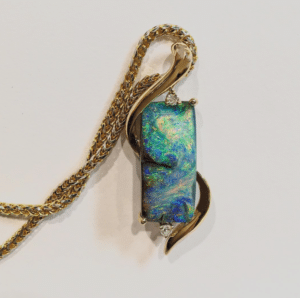
Pattern refers to the way the play of colour is arranged across the surface of the opal. Some patterns are common, while others are exceptionally rare and highly sought after.
Buyers may look for certain patterns, such as:
- Harlequin: The rarest pattern, featuring a checkerboard or mosaic arrangement of diamond-shaped patches.
- Flagstone: Large colour patches separated by dark boundaries.
- Ribbon: Parallel strips of colour that move across the stones.
- Pinfire / pinpoint: Numerous tiny specks of colour, closely set to resemble stars.
- Chinese writing: Flashes of colour that resemble intricate calligraphy.
- Rolling Flash: A bright, large band of colour that moves across the stone as it is trimmed.
7. Inclusions
Inclusions are natural internal or surface features formed as the opal develops in its geological environment. In opals, these can include sand, potch, host rock remnants, grey lines, cavities, fractures, pits or areas where colour is weak or absent.
Some inclusions do not impact the value of the opal, especially in boulder opals, where the host rock is part of the character of the stone.
8. The weight and cut
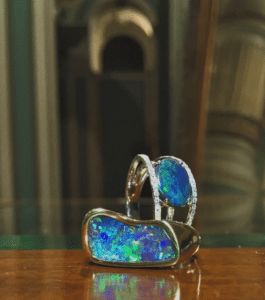
Like diamonds, opal weights are measured in carats. 1 carat is equal to 0.2 grams. While carat weight does matter, a small opal with extraordinary colour can be worth far more than a larger stone with weak brightness or poor pattern.
Cut is especially important in opal because lapidaries are trying to reveal the strongest possible play of colour while preserving as much valuable material as possible.
Common opal shapes include:
- Oval cabochon: A classic opal shape, usually with a rounded dome.
- Round cabochon: Balanced and traditional. Often used in rings.
- Pear or teardrop: An elegant choice for pendants and earrings.
- Freeform: Shaped around the colour bar or natural contours of the rough.
- Specimens: Opal carvings cut into sculptural or organic forms that highlight the material’s natural character.
10: Treatment process
Opals can also be treated to improve their colour, appearance and durability. They can be smoked, treated with sugar-acid, dyed or filled with resin, oil or polymers. These processes can have an impact on an opal’s value, as they alter the natural composition of the gemstone.
While technically a manufacturing process and not a treatment, the assembly of doublet and triplet opals also fits into this category.
Final Thoughts
A beautiful opal combines a strong body tone with a vivid play of colour, excellent brightness, an attractive pattern, a clean face-up appearance and a cut that makes the most of the material. The most valuable opals were found in a desirable location and have had their natural beauty preserved by expert cutters and jewellers.
However, value is only part of the story. Opals are deeply individual gemstones. Some buyers are drawn to bold flashes of red in black opal, while others prefer the earthy character of boulder opal or the softer glow of a light stone.
Now that you’re aware of what to know when buying an opal, it might be time to start looking for your next piece. Visit Volle Jewellery’s store in the Sydney CBD to browse our collection of opal rings, pendants, earrings and bracelets.
More FAQs about opals
Do all opals glow under a blacklight?
No. Opals can exhibit different behaviour under blacklight. Some may show fluorescence; others may not react at all. Unusual behaviour under UV light could be a sign that the opal has been treated.
Does real opal turn clear in water?
Not necessarily. Hydrophane opals can absorb water and temporarily appear transparent. Most opals do not behave this way.
How to tell if an opal is solid?
A solid opal is a single piece of opal rather than an assembled stone. An easy way to check is to look at the side of the stone and see if you can spot a clear join line between layers. A triplet, for example, usually has a thin opal slice between a dark backing and a clear top cap. A trusted jeweller or gemmologist can confirm this if you are unsure.
What is the best opal grade?
There is no single grade that is ‘better’ than another. The N1 to N9 scale is used to measure the body tone of opals, with a lower number equating to a darker base, greater contrast and – typically – a higher value.
What is the most valuable opal colour?
The black opal is generally considered the most valuable type of opal. Its dark body tone creates a stronger contrast, which allows the play of colour to appear more vivid. That said, any opal that displays a broad play of colour from multiple angles, strong brightness and an attractive pattern has the potential to be very valuable.