Blog
“The pearl is the queen of gems and the gem of queens.”
– Grace Kelly
What are pearls?
Pearls are different from other gems in that they come from living creatures. Found in the shells of molluscs (oysters and mussels), these lustrous stones come in a variety of colours, including white, black, pink and green.
Although pearls are known for their spherical shape, these are actually the rarest variety. More commonly, pearls form in oval, semi-round, pear, drop, button or baroque shapes.
Some of the most desirable pearls come from specific oyster species. The Pinctada margaritifera oyster, for example, produces Tahitian pearls in distinctive dark body colours with overtones of green, peacock and silver. South Sea pearls originate from the Pinctada maxima, which gives them their large size and satin-like white, silver or gold glow.
How are pearls made?
Although some pearls can be artificially made, natural pearls occur when a parasite enters the mollusc. Over time, the mollusc will cover the parasite and begin to form layers of ‘nacre’ around it.
Nacre is composed of tiny platelets of aragonite (calcium carbonate), which build gradually in a tightly packed structure. Layered nacre builds the soft iridescence we imagine when we think of what a pearl looks like.
The process of nacre layering can take several years, depending on conditions in the water and the health of the mollusc. Irritants can be rejected, meaning there is no resulting pearl, while some nacre can form unevenly.
What is ‘nacre’?
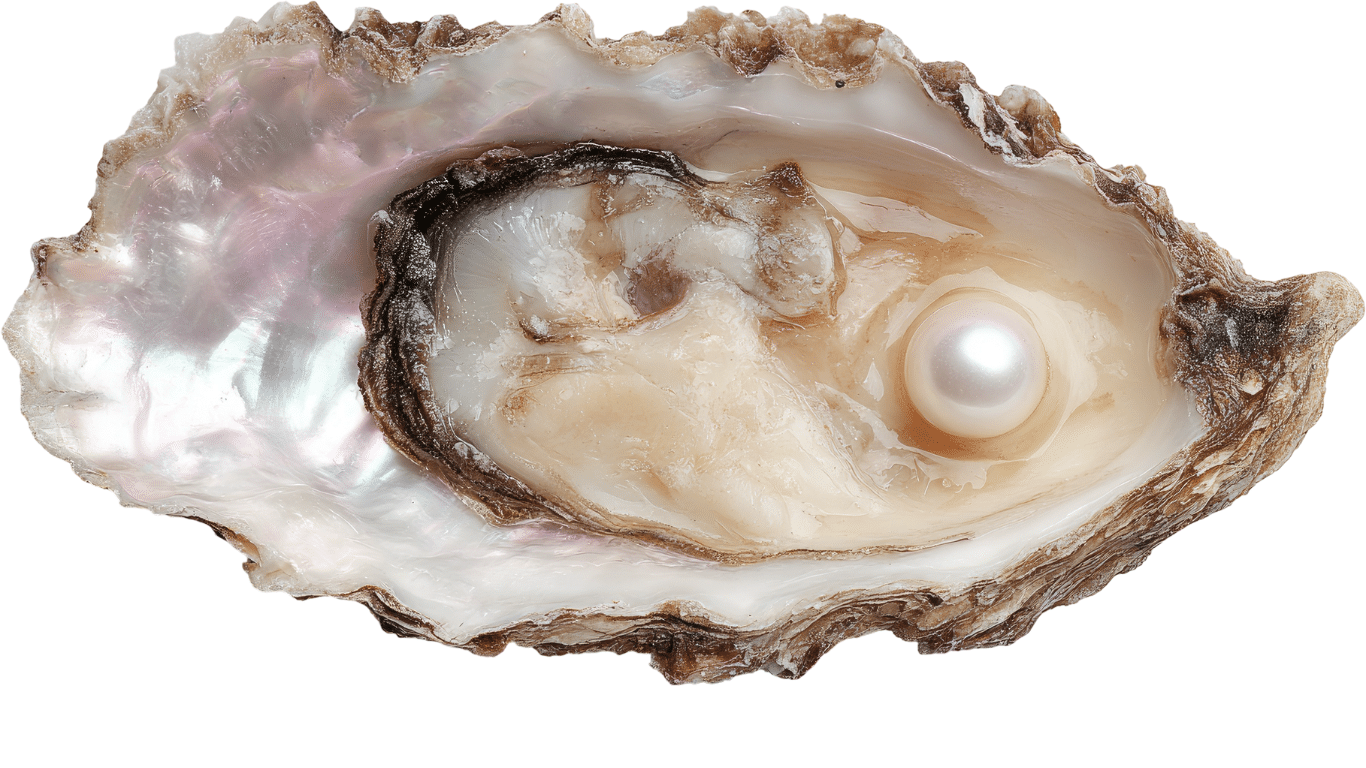
Look inside any oyster and you’ll see a beautiful iridescent material lining the shell. This is nacre. As this material continues to layer around the parasite, a pearl is formed. The thicker
the nacre, the more durable the pearl.
Nacre forms in microscopic layers, stacked in a brick-like structure. The process is slow, and nor do all oysters have pearls inside. In fact, out of the 8,000 different species of molluscs, only 20 (or 0.25%) of them regularly form pearls.
Cultured pearls vs natural pearls
Because naturally occurring pearls are extremely rare, you will often find ‘cultured pearls’. These are formed in the same way as a natural pearl, except that instead of a parasite finding its way into the mollusc, a shell bead nucleus is placed inside the oyster.
What is a shell bead nucleus?
A shell bead nucleus is a small, perfectly round bead that is carefully placed inside the oyster during cultivation. It is typically carved from the shell of a freshwater mussel and acts as a stable core for layers of nacre to form around.
As the nucleus is already perfectly round, it often guides the shape of the pearl. This is the reason why saltwater cultured pearls are usually spherical and consistent in size.
Freshwater vs saltwater cultured pearls
There are two main categories of cultured pearls: freshwater and saltwater. Freshwater pearls tend to be seen as less valuable, but they come in a larger range of shapes and colours. Saltwater pearls, on the other hand, are more valuable and can be found in different locations. Understanding the differences between the two also helps explain why pearls are so expensive in some cases and more affordable in others.
| Feature | Saltwater cultured pearls | Freshwater cultured pearls |
| Biological Host | Pinctada fucata (Akoya), Pinctada margaritifera (Tahitian), Pinctada maxima (South Sea) | Freshwater mussels in the Hyriopsis genus |
| Primary environment | Oceans, lagoons, protected marine bays with stable salinity levels | Rivers, lakes, freshwater ponds |
| Nucleation method | Round shell bead nucleus surgically inserted. Oyster deposits nacre around the bead | Nucleated by a small piece of mantle tissue |
| Yield per harvest | 1 pearl per cultivation cycle. Not all oysters survive | 20-40 pearls from a single mussel |
| Nacre composition | Tightly compacted, microscopic layers of aragonite | Aragonite platelets and organic binding material |
| Growth timeline | 2-4 years | 2-3 years |
| Lustre quality | Deep, mirror-like satin lustre | Softer glow |
| Shape consistency | Round, symmetrical pearls | Oval, button and baroque more common than perfectly round pearls |
| Value and rarity | More expensive due to lower yield and longer cultivation | More affordable due to production volumes and higher yields |
How do pearls get their colour?
Although most people will be familiar with the image of a white pearl necklace, these gems come in a variety of stunning colours, including black, green, pink and gold. Although some jewellers will dye pearls to achieve this colour artificially (which has impacts when it comes to taking care of pearl jewellery), there are several natural factors which affect a pearl’s colour. These include:
- The shell, which influences the colour of different types of pearls. For example, black Tahitian pearls can be found in the Pinctada margaritifera oyster that originates in French Polynesia and has a silver shell. It is the only mollusc to form black pearls naturally. Similarly, golden South Sea pearls are created by the gold-lipped oyster in Philippine and Indonesian waters, while white and silver variants are found off the coast of Western Australia. Akoya pearls are formed in the Pinctada fucta oyster in Japanese and Chinese waters, the latter of which also produces most freshwater pearls.
- The thickness of the nacre. The thicker the nacre (and the longer the pearl has been growing), the more vibrant its colour will be. If there is only a thin nacre, the pearl’s colour will be less intense and it will not appear as shiny.
- Irradiation treatment. In this process, the pearl is hit with gamma rays that darken it. For saltwater pearls, this results in a silvery or gunmetal colour. For freshwater pearls, this results in a black pearl with high lustre.
Sustainability of pearl harvesting
Today, most pearls are cultured in controlled farms, which reduces pressure on wild populations. Responsible pearl farms carefully manage water quality, limit stocking densities and protect surrounding ecosystems. For buyers, it’s important to choose a jeweller who can explain where their pearls come from and how they’re farmed to ensure your purchase supports responsible practices.
Find the perfect pearl jewellery at Volle
Want to find your perfect pearl? Get in touch with the team at Volle today. We’ll explain the technical terms, show you how to tell if a pearl is real and discuss each individual piece’s rarity and value.
Whether you’re searching for opals, diamonds or pearls, visit our store in Sydney to find the piece that best suits your style.