Blog
Opal and sapphire are two of the most desirable gemstones used in the creation of fine jewellery. Sapphire is known for its rich blue colour and for being one of the hardest stones available. Opals, meanwhile, have earned worldwide fame for their mesmerising play of colour. It’s unique to each opal.
The choice between a sapphire and an opal will come down to your personal style and how you plan to wear your jewellery.
Volle Jewellery’s in-house gemmologists specialise in verifying the authenticity of Australian opals.
In this guide, we compare sapphire and opal in terms of appearance, durability, value and collectability to help you choose the right stone to use as the focal point of your next piece.
Key takeaways
- Sapphire is the harder stone. Sitting at 9 on the Mohs scale, it suits jewellery worn every day.
- Opals are more unique. Every natural opal has its own pattern and play of colour.
- The value of both gemstones depends on quality. Fine examples of either will command a higher price.
- Sentimental attachment differs. Opal is October’s birthstone, while sapphire is September’s.
Sapphire vs Opal: The Main Differences
Sapphire and opal are very different in terms of structure.
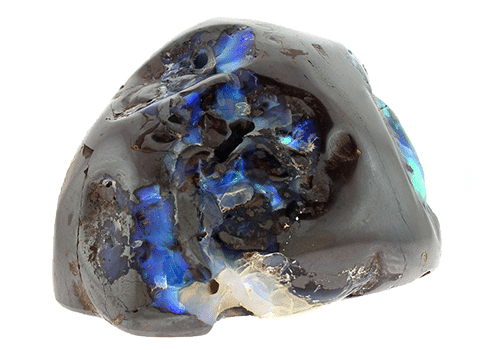
An opal forms when silica-rich water collects in weathered rock and settles into stacked spheres that harden over millions of years. The play of colour forms as light separates when it travels between those spheres.
Sapphire, meanwhile, is a form of crystalline corundum. While it is known for its deep blue colour, sapphires are found in a range of other hues.
These structural differences impact how each stone responds to wear and the maintenance it requires. Sapphire is harder and more durable, but opal will last just as long with some basic care.
There are several different types of natural solid opal. Our guide comparing black and white opals explains the differences between these varieties in more detail.
At a glance
| Feature | Opal | Sapphire |
|---|---|---|
| Composition | Hydrated silica | Crystalline corundum |
| Signature look | Changing play of colour | Strong blue body colour (also found in other hues) |
| Hardness (Mohs scale) | 5.5 to 6 | 9 |
| Everyday durability | Suits more occasional wear but lasts well when cared for | Well suited to regular wear with basic care |
| Value driver | Play of colour, body tone, brightness and pattern | Origin, treatment and appearance |
| Birthstone month | October | September |
Opal vs Sapphire: Durability for Everyday Wear
Sapphire sits at 9 on the Mohs scale, making it one of the hardest gemstones used to create jewellery. That strength makes it popular for pieces worn every day. Sapphire jewellery can be cleaned using warm soapy water and a soft brush. GIA provides further guidance on caring for sapphires.
Opal scores 5.5 to 6 on the Mohs scale. It’s softer than sapphire and contains more water within its structure. While opals benefit from more careful wear, they are relatively easy to keep looking great with some basic cleaning. A simple wipe with a damp cloth is usually enough to make sure an opal still looks its best. It’s also best to store opals away from other jewellery and to remove your pieces before doing any heavy work or physical activities. Find out more in our guide to taking care of opals.
The setting also helps protect the stone. Its metal bezel surrounds the edge of the opal, ensuring it remains protected while you’re wearing it. Our gemmologists, who specialise in solid Australian opals, will help you choose a setting that suits both the stone and the way you plan to wear your jewellery.
Opal vs Sapphire: Value
The values of both opal and sapphire vary depending on the quality of the individual stone. However, the factors used to determine these prices are very different.
In a sapphire, colour is one of the most important considerations. Gemmologists also look at origin and treatment when assessing the stone.
The process is a little different when determining what makes a good opal. The play of colour directly influences the stone’s value, but it isn’t the only characteristic which does so. A darker body tone makes the colours in an opal appear stronger, which is why the black opal is so valuable. Brightness is also important, as a smaller stone that displays strong colours can be more valuable than a larger stone which doesn’t. To find out more, read our guide on how opal grading works.
Opal vs Sapphire: Engagement Rings
Opal and sapphire both create beautiful engagement rings, but they suit different visual tastes.
Sapphire’s greater hardness makes it well suited to a ring that will be worn every day, while its striking body colour is an appearance many people fall in love with.
Alternatively, an opal’s unique pattern and play of colour make each ring feel individual to its wearer.
Discover our range of opal rings to see how different stones and settings complement each other. If you’re ready to take the next step, you can also browse our range of loose opals and design the ring of your dreams around the stone that speaks to you.
Expert tip: View an opal under more than one light source before buying. Moving the stone under artificial and natural light sources will show how the play of colour changes in different settings.
Why Australian Opal Stands Apart
Opal is Australia’s national gemstone. In fact, Geoscience Australia reports that the country produces 95% of the world’s precious opal.
Australian opal is valued for its origin and the captivating play of colour it produces.
Different areas are also known to produce different types of opal. Lightning Ridge, for instance, is famous for its black opal.
Volle’s in-house gemmologists examine each opal in our collection for colour, pattern and structure. Those stones are the starting point for your dream piece of fine jewellery.
FAQs
Is sapphire better than opal?
It depends on personal preference, as neither gemstone is “better” in every situation.
Sapphire is harder than opal, making it a practical choice for jewellery that will be worn regularly. It also has a strong, consistent body colour that many people appreciate.
In contrast, opal offers a breathtaking play of colour that is unique to each stone. This makes it a popular choice for creating custom jewellery.
Choose between the two based on how you will wear your jewellery and which stone you prefer the appearance of.
What is worth more, sapphire or opal?
Both gemstones are valued according to the quality of each stone. In a sapphire, colour, treatment and clarity all influence the value, while gemmologists consider the play of colour, body tone, brightness and pattern when assessing an opal.
Which zodiac sign should not wear opal?
This question comes from astrology and belief, rather than any gemmological fact. Vedic astrology associates opal with Venus. Some traditions suggest that opals should not be worn by people of Leo, Cancer or Sagittarius, but some sources disagree on the grounds that there is no scientific basis for this claim.
In Western tradition, opal is October’s birthstone and can be worn by anyone.
See our guide to common myths about opals for more widely held beliefs about the gemstone.
Are opals bad luck?
No. The idea that opals bring bad luck became more widely known after Sir Walter Scott published his 1829 novel Anne of Geierstein, in which an opal is connected to the subsequent misfortunes of its wearer.
Opal had positive meanings long before that story appeared. The Romans associated it with hope and valued it for the range of colours it displayed.
Today, people choose to wear an opal for many reasons, from colour to personal meaning.